
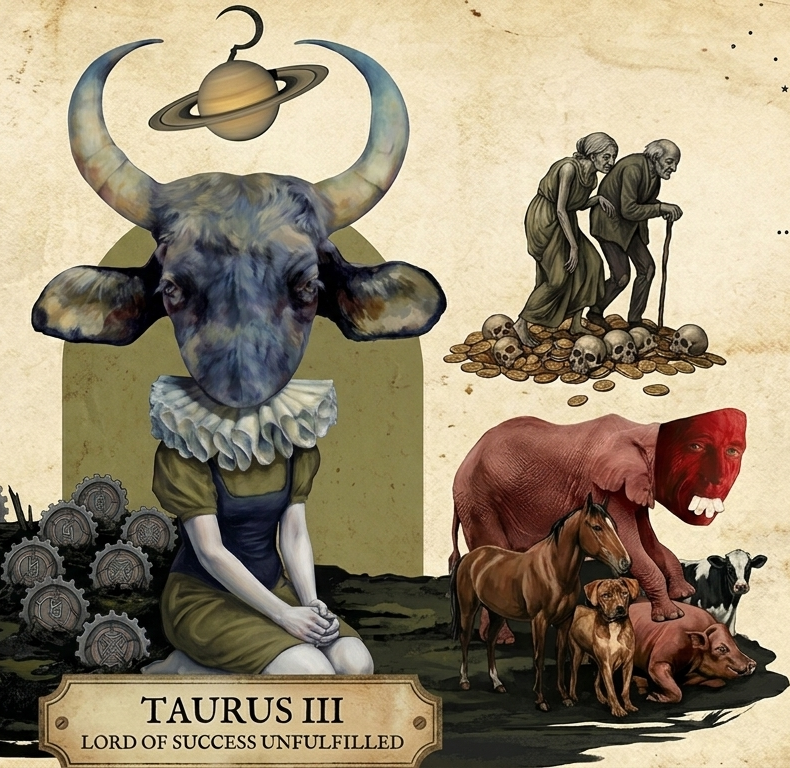
The Sacred Pause: Taurus III, the 7 of Pentacles & the Art of Waiting Well
It’s mid-May and I’m standing in my backyard with flowers I probably bought too early. The last frost warning hasn’t fully lifted, the soil is somewhat cold, and I know better — but I bought them anyway. They’re sitting on my porch in their little plastic cells, waiting. I’m waiting. Everything is ready except the conditions.
That, right there, is Taurus III in the flesh.
This final ten degrees of Taurus (roughly May 11–21) is one of the most underestimated stretches of the astrological calendar. It looks like stillness from the outside. From the inside, it feels like standing at a door you’ve already knocked on, wondering if anyone’s home. You’ve done the work. You’ve prepared. And now — nothing. Just the waiting, the hoping the frost doesn’t come, and the quiet, creeping question: was this all for nothing?
It wasn’t. But let’s talk about why.

New to decan walking?
✓ Visit my free resource guide to get started
What Is Taurus III? Venus Hands the Keys to Saturn
If you’re here with me, I’m going to assume you have at least a passing familiarity with astrology — but if you don’t, here’s what you need to know for this post to make sense.
The zodiac is divided into 36 decans — three ten-degree segments within each of the twelve signs. Each decan has its own planetary ruler layered on top of the sign’s ruler, which gives it a distinct flavor from the rest of the sign. Think of it like a neighborhood within a city. Taurus is the city. Taurus III is a very specific, very particular part of town.
The key players: Venus and Saturn
| Correspondence | Venus | Saturn |
| Rules | Taurus, Libra | Capricorn, Aquarius |
| Element | Earth, Air | Earth, Air |
| Quality | Receptive, attractive | Restrictive, structuring |
| Wants | Beauty, pleasure, ease, abundance | Time, labor, discipline, limits |
| Fears | Scarcity, ugliness, discomfort | Chaos, impermanence, loss |
| Body | Throat, kidneys | Bones, teeth, skin |
| Metal | Copper | Lead |
| Season | Spring bloom | Late autumn, winter |
Taurus as a whole is ruled by Venus — sensual, abundant, slow-moving in the best possible way. Early and mid-Taurus is the lush heart of spring: things are growing, the senses are alive, life is generous. But when we reach the final decan, something shifts. Under both the Chaldean (planet-based) and Triplicity (element-based) rulership systems, Taurus III is handed over to Saturn. Venus keeps her home, but Saturn is now setting the rules inside it.
This is the densest, heaviest pocket of Earth energy in the entire zodiac wheel.
Taurus is already a fixed sign — meaning it resists change, digs in, and stabilizes. It is the sign of “I will endure.” Add Saturn’s cold, contracting weight on top of that fixed earth, and you get energy that is simultaneously deeply productive and profoundly immovable. Things here take time. They require patience. They demand that you learn the difference between giving up and giving over.
For a deeper dive into what Saturn really means — not just as a transiting planet but as a fundamental principle in the psyche — I can’t recommend Liz Greene’s Saturn: A New Look at an Old Devil enough. It reshaped my entire understanding of this planet.


The Sickle and the Seed: Agrippa’s Vision of This Decan
The Renaissance magus Heinrich Cornelius Agrippa, in his Three Books on Occult Philosophy, described the image of this decan as a man ascending with a sickle in hand, gathering fruit — a face of “industry, nobleness, and strife.”
The sickle. We know that symbol. We associate it with the Grim Reaper, with death, with endings. And that’s not wrong, but it’s only half the story.
In an agricultural context, the sickle is not a symbol of meaningless destruction. It is a necessary tool. The crop must be cut down so that people can eat. The field must be cleared so that next season can begin. In nature, death and harvest are the same gesture. Things have to end for life to continue.
This reframe is everything for understanding Taurus III.
The relentless, and almost compulsive work ethic of this decan isn’t really about ambition. It isn’t greed. It’s something more than that — it’s the Saturnian anxiety of loss. The farmer who works from before dawn until after dark doesn’t do it because he loves to work. He does it because he has felt — or imagined— what it means when the harvest fails. When the frost comes. When the preparation wasn’t enough.
There is a deep fear of groundlessness woven into this decan. And from that fear, a capacity for endurance.
The Mythology: Ate, the Litai, and Radical Supplication
This is the part most people skip, and I think it’s the most beautiful piece of the whole puzzle.
In Homeric mythology, there is a goddess named Ate — the spirit of delusion, recklessness, and ruin. She dances across the heads of mortals, light-footed and wild, scattering disaster behind her. She doesn’t linger. She moves fast, and she leaves wreckage.
Following behind her — slowly, limping, struggling to keep up — are her sisters, the Litai (the Prayers). In The Iliad, Book 9, the elder Phoenix describes them this way: they are wrinkled, one-eyed, and lame. They cannot match Ate’s pace. By the time they arrive, the damage is already done.
But their purpose is repair.
The Litai are the ancient Hermetic rulers of this decan, and they represent something that our culture has largely lost the language for: supplication. Not polite prayer. Not a quiet request sent upward with your fingers crossed. Supplication is the act of throwing yourself at the knees of something larger than yourself. This can be a complete public prostration, it’s meaningful and dedicated.
In the Hellenistic astrological tradition, placements in this decan were said to indicate a person who would eventually be forced to “set aside their dignified facade.” Taurus III is the energy of someone who has built and built and built — and then had to fall to their knees and ask for help.
The Litai’s bodies tell the whole story. Wrinkled — worn by Saturn’s relentless passage of time. Lame — unable to rush, unable to force. One-eyed — their vision is limited, partial, human. They can’t stop Ate. They can only follow after, offering the possibility of restoration to those willing to receive it.
The shadow face of this decan — what it looks like when someone refuses the Litai’s gift — appears in the Picatrix, one of the great medieval grimoires of magical astrology. It describes the image of this decan as a ruddy, unreasonable man with enormous white teeth protruding past his lips, riding through a landscape of poverty, misery, and fear. There is something almost grotesque about that image: the man still rigid, still charging forward, teeth bared — unable to be reached, unable to receive repair.
The Cards: RWS vs. Thoth — Two Ways of Seeing the Same Wall
For me personally, this time I wanted to dive into the Thoth system. I’m pretty well versed in RWS, but Thoth, I need help with- so while I did my research, there may be better sources on the Thoth side of things. So here we go –
The 7 of Pentacles is the tarot card assigned to Taurus III, and I want to look at it through both the Rider-Waite-Smith and Thoth systems, because they’re telling the same story in dramatically different emotional registers.
The Rider-Waite-Smith: The Farmer’s Posture
Arthur Edward Waite’s version, illustrated by Pamela Colman Smith, shows us a farmer leaning heavily on his hoe. In front of him is a vine heavy with pentacles — the crop is almost there. Almost. He’s not harvesting. He’s not planting. He’s just… standing there, looking at it.

Look at his posture. He’s not triumphant. He’s not relaxed. He’s exhausted in that specific way that comes not from doing, but from waiting. He has done everything in his power. The vine is proof of that. And now he has entered the space that no amount of effort can shorten: the space between human action and natural timing.
The weather could still turn or a huge tornado could come- you never know. The crop is out of his hands now, and the expression on his face may or may not indicate he knows it.
The Thoth: Lead Made Visible
Aleister Crowley’s Thoth deck takes a harder look at the same moment. The card’s esoteric title is “The Lord of Success Unfulfilled” — sometimes simply called Failure. That word tends to alarm people. I find it beautifully saturnine. As a Capricorn rising, I definitely give love to my Saturn. The thoth system for me personally resonates with the astrology of Saturn in the card. I don’t get the vibe of Saturn so much from the RWS.
In the Thoth system, the 7 of Pentacles shows seven discs arranged in the pattern of the planet Saturn (♄ shape) — but the energy flowing between them has gone inert. Where the RWS gives us a living vine and a tired farmer, the Thoth gives us something more alchemical: lead that hasn’t been worked. Potential that has coagulated into deadweight.
The planetary symbolism here is explicit. Venus (copper, softness, longing) is under the dominion of Saturn (lead, coldness, weight). The discs in this card carry that tension visually — you can almost feel them pulling downward. This isn’t a card of failure as defeat. It’s a card of failure as calcification — what happens when the volatile creative force gets stuck in the material world and can’t move.
The Thoth card is what the RWS farmer’s inner monologue sounds like at 3am.
What they agree on
Both cards ask the same fundamental question: Can you hold on through the pause?
The RWS asks it through a body — through posture, through the weight of waiting made physical. The Thoth asks it through symbol — through the alchemical language of metals and planets in conflict. Together, they map the full interior landscape of Taurus III: the outer stillness, the inner turbulence, and the invitation to stay present with both.
Kabbalah, Alchemy, and the Art of Composting
For those who work with the Western esoteric tradition: the 7 of Pentacles sits at Netzach in Assiah on the Kabbalistic Tree of Life. Netzach is the sphere of Victory — raw desire, passion, the creative force of nature in its most primal form. Assiah is the world of physical matter, of doing and making and touching. When you put them together, you get the experience of longing colliding with limitation. Of wanting to birth something into the world and running headlong into the brick wall of time.
The alchemical process at work here is Nigredo — the blackening, the putrefaction, the phase where the material must rot before it can be transformed. Saturn is lead. Taurus is the field. And right now, the seed is underground where you cannot see it, doing the invisible work of becoming.
Carl Jung (my absolute favorite), who engaged deeply with alchemical symbolism, described the Nigredo as the moment when “the massa confusa appears” — the dark chaos before the new form emerges. It looks like nothing. It feels like failure. It is, in fact, the necessary precondition for everything that comes next.
If you want to go deeper into the Nigredo concept and what it means psychologically, this episode from This Jungian Life is one of my all-time favorites: Episode 107 — Nigredo: Finding Light in Our Darkness.
The Stoic Frame: On Doing Your Work and Releasing the Outcome
I came to Stoicism the way a lot of people do — sideways, through a difficult season, looking for something that wasn’t just comfort but actual traction. And what I found wasn’t a philosophy about being unmoved. It was a philosophy about being clear — about knowing what is yours to do and what is not.
The Stoics called it the dichotomy of control. Epictetus put it plainly: “Make the best use of what is in your power, and take the rest as it happens.” You plant. You water. You tend. The harvest — the actual harvest — belongs to time, to weather, to factors you cannot govern. The Stoic move is not detachment. It is the radical act of doing your absolute best and then genuinely, fully releasing the outcome. (That was a really great read)
Marcus Aurelius wrote in his Meditations: “You have power over your mind, not outside events. Realize this, and you will find strength.”
That is Taurus III to me. That is the 7 of Pentacles. You’ve already done the work. You’ve prepared more than you needed to (I bought too many flowers, remember?). The Saturnian anxiety is already baked in — you know what loss feels like, which is why you worked so hard in the first place. But at a certain point, the work is done. And the Stoic question is: can you put down the shovel without putting down yourself?
For me, this showed up recently in the sheer, staggering weight of a new operational rollout at my day job. I am someone who builds structures for a living; I map out strategies, track daily metrics, and coordinate team assignments down to the letter. When a massive new portfolio landed on my desk, my immediate Saturnian response was to over-prepare out of an instinctual fear of failure. I built mapping files, adjusted dialer strategies, worked early mornings, and double-checked agent credentials until I was staring at a flawlessly constructed engine of productivity. I had done everything humanly possible to ensure stability.
And then, the system launched, and the timeline completely stalled due to factors entirely outside of my control.
In that moment of intense friction, the old me wanted to micromanage the delay, to stay late, and force the gears to turn through sheer willpower. But looking at the 7 of Pentacles from a Stoic frame forced a brutal realization: my labor was complete. The structure was sound. The rest belonged to the gravity of time. I had to learn how to walk out of the office at 5:00 PM, leave the tracker exactly where it stood, and trust the containment of my own boundaries. Putting down the shovel didn’t mean I failed; it meant I finally respected the limits of my own control.
The Stoics also had a concept called amor fati — love of fate. Not tolerance of fate, not resignation to fate, but an active, willing embrace of what is. Not just the beautiful parts. The frost warnings, too. The waiting. The flowers are sitting in their plastic cells on the porch. Amor fati says: this too is the thing. I think that’s where the Saturnian fear comes from. Fate is so unknowable, and we fear that unknown.
Maybe that’s what’s on the farmer’s mind, who knows.
I’m a total sucker for Sabian symbols, so I was curious and looked up some of them from this decan. The Sabian symbols associated with the final degrees of Taurus (20–30°) were a total chef’s kiss. A few that stood out to me:
22° Taurus — A white dove over troubled waters. After the storm. After the flood. The dove doesn’t fix the troubled waters. It simply appears, bearing witness, offering the signal that something new is possible. This is the Litai, moving slowly toward the wreckage.
29° Taurus — Two cobblers working at a table. The dignity of ordinary labor. Not glory, not recognition — just two people, side by side, doing what needs to be done. This is Taurus III’s work ethic at its most honest: not heroic, not celebrated, just steady.
30° Taurus — A peacock parading on an ancient lawn. The final degree, the closing image. Beauty that has survived everything. Endurance made gorgeous. The peacock doesn’t apologize for its plumage. It has earned the ancient lawn by simply continuing to exist on it.
Your Decan Walk Prompt for Taurus III
Before I let you go — if this decan is active for you right now, here is a portential question I want you to sit with:
Where in your life have you already done the work, and are now making yourself wrong for the waiting?
Take that question outside if you can. Feel the actual weight of your feet on the ground. Let Saturn have your bones for a minute. And then ask yourself: what would it look like to tend the vine — and let the vine do the rest?
The frost might come. It might not. Either way, you bought the flowers. That already counts for something.
If this post resonated with you, I’d love to hear where you are in your own decan walk journey or how Taurus III decan feels to you. Drop a comment, or find me over at officialmeliora.com.
Further reading & listening:
- Liz Greene — Saturn: A New Look at an Old Devil
- This Jungian Life — Episode 107: Nigredo, Finding Light in Our Darkness
- Agrippa, Heinrich Cornelius — Three Books on Occult Philosophy
- Homer — The Iliad, Book 9 (Phoenix’s speech on the Litai)
- Cathy Gnatek Astrologer LLC
- https://www.youtube.com/watch?v=ABoL1GRV5ys- “ fail better “ – I found this and really enjoyed her content! Follow @midlifeenchantments on #Tarotube
- Erin Lento did a decan walk too! @Thewitchofsaturn
🔮 Work with Me / Explore More