
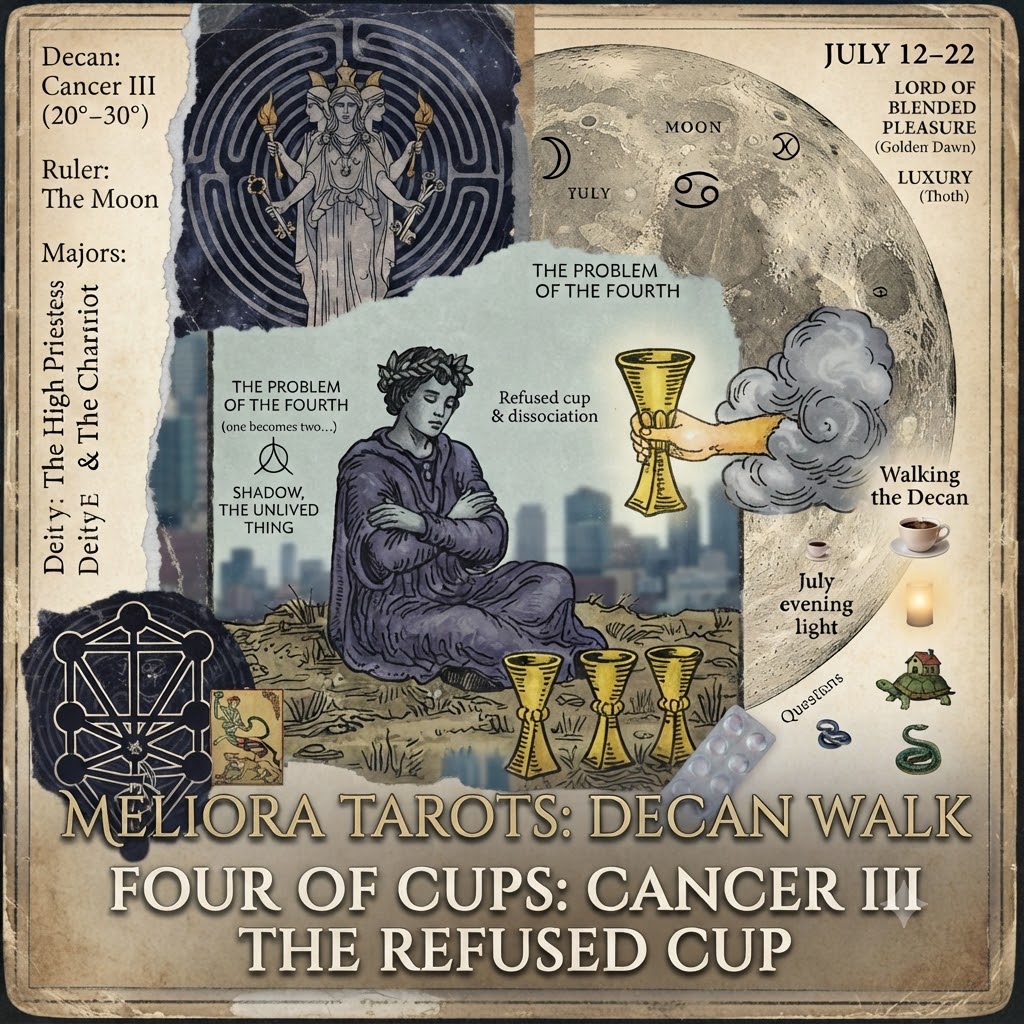
Cancer 3: Four of Cups | Moon in Cancer | July 12–22
Lord of Blended Pleasure (Golden Dawn) | Luxury (Thoth)
Majors: The High Priestess (Moon) drives The Chariot (Cancer)
Welcome to the most lunar place in the entire zodiac. Cancer is the Moon’s home sign, and in this last decan, the Moon rules its own face inside its own domicile. Water on water. Feeling soaked in feeling. Add the Jupiter flavor of the Fours and you get the Thoth title in one word: Luxury. Everything the Moon governs — memory, tide, nourishment, the ancestors, that womb-dark interior world — hits full flood right here.
And yet the Golden Dawn calls this the Lord of Blended Pleasure. Blended with what, exactly? That one word is the whole riddle of the decan. This is pleasure with something dissolved into it — a drop of bitterness, a faint metallic taste of enough. If you’ve ever floated in the ocean at absolute high tide, you know there’s this strange held-breath stillness. The water is deep and going nowhere. Nothing is wrong, exactly. But nothing is moving, either.
Correspondences at a Glance
| Decan | Cancer III (20°–30° Cancer) |
| Dates | July 12 – July 22 |
| Ruling Minor Arcana | Four of Cups |
| Hermetic Title | Lord of Blended Pleasure (“Luxury” in the Thoth) |
| Sign Ruler | The Moon |
| Decan Ruler (Chaldean) | The Moon — its own face, in its own domicile |
| Number Influence | Fours — Jupiter; Chesed in Briah on the Tree of Life |
| Corresponding Majors | The High Priestess (Moon) + The Chariot (Cancer) |
| Element / Quality | Water / Cardinal (cadent decan) |
| Decan Image | A swift-footed figure with a viper in hand, leading dogs |
| Deity (36 Airs) | Hecate |
| Preceding Decan | Cancer II — 3 of Cups (Mercury) |
| Following Decan | Leo I — 5 of Wands (Saturn) |
| Core Theme | Fullness gone still; the gift refused; abundance waiting on meaning |
Explore the free Decan Walk Resources Here
The Image of the Decan
The traditional face for the decan of Cancer III is a weird one: a swift-footed figure with a viper in hand, leading hunting dogs. M.M. Meleen, in her Tabula Mundi decan walk, models this runner on the lunar huntress Artemis herself — perfect for a doubly Moon-ruled decan — and points to the mythic shadow lurking behind the image: Actaeon, who saw what he shouldn’t have and went from hunter to hunted in a heartbeat.
The older decan lists get even stranger. T. Susan Chang, surveying the traditional images, spots two motifs that keep repeating. First: treasure and adornment. Figures dripping in jewels, sailors crossing oceans to fetch gold for their wives’ rings. The Latin Picatrix ties this face to pursuit, contention, grabbing things through struggle. Chang’s read on all this is brilliant — the treasure is a cosmic McGuffin. Nobody actually cares what’s in the chest. What matters is the chase, the drama of wanting.
The second motif is odder still: snakes and turtles, sometimes stuck together in the same figure. And her decoding of it is basically the skeleton key to this whole card. The turtle carries its complete home on its back — we already have everything we need — while the serpent hungers onward — and still we want more. Hunger breeds hunger.
Oh, and the Hellenistic 36 Airs assigns this face to Hecate. Triple-formed goddess of the crossroads, keeper of the dark Moon. Hold onto her. She comes back at the end, and it’s good.
Three Cups, and a Fourth from a Cloud
You know this image. A young man sits cross-armed under a tree. Three cups stand in front of him in a tidy row — his, accounted for, complete-looking. From a little cloud, a hand extends a fourth. He doesn’t even look at it.
Etteilla’s keyword for this card was simply ennui. Waite describes weariness and disgust — a wastrel for whom the wine of the world has produced nothing but satiety. Meleen connects the card’s mood to anhedonia, that flat inability to feel pleasure even while surrounded by everything that should produce it. And she reminds us that the Fours sit just below the Abyss on the Tree of Life: the first place the suit’s ideal takes stable form — which makes it the first place it can stall. Fours crave stability, but their stability never lasts. It’s a plateau, with the disruption of the Fives already gathering offshore like a wave.
So the question the card asks isn’t what does he have? It’s why can’t he feel it?
What Jung Would Say
Okay, here’s where the card stops being a picture of boredom and becomes a diagram of the psyche — because there’s a Jungian reading here so on-the-nose it almost feels planted.
Jung spent his whole career circling what he called the problem of the fourth, crystallized in the alchemical Axiom of Maria: one becomes two, two becomes three, and out of the third comes the one as the fourth. For Jung, three is the number of apparent completeness — the tidy trinity, the conscious arrangement, the three functions your ego has learned to drive. The fourth is the missing piece: the inferior function, the shadow, the unlived thing. And here’s the catch — the fourth never shows up on your terms. It rises from the unconscious, and it always looks wrong somehow. Too humble, too weird, too inconvenient to possibly be the missing piece of your wholeness.
Now look at the card again. Three cups in conscious possession, lined up on the ego’s home turf. A fourth, offered from a cloud.
In tarot’s visual grammar, the hand-from-a-cloud is how the deck shows autonomous psychic content — it’s the same hand that delivers every single Ace. Gifts arriving from beyond the ego’s jurisdiction. If you’ve ever practiced active imagination, you know this hand. It’s the image that surfaces unbidden, the dream figure who holds something out and waits. Jung’s whole method comes down to one discipline: when the unconscious offers, you take the cup. You engage, you drink, you let the content into consciousness where it can transform you and be transformed. The figure in the Four of Cups is a portrait of the alternative — arms crossed, eyes down, the transcendent function politely declined. Individuation doesn’t fail here through catastrophe. It fails through refusal.
And why does he refuse? The lunar saturation of the decan gives us the answer. The Moon, in Jung’s symbolic vocabulary, belongs to the mother-world — the containing, nourishing, encircling matrix. Cancer III is the mother archetype cranked to maximum, and Jung was blunt about the fact that the great mother has two faces. The same container that nourishes can enclose. In Symbols of Transformation he describes the regressive pull of the maternal unconscious — the longing to sink back into what’s known, warm, and complete, which feels like comfort right up until it becomes captivity. The listless tree, the windless air, the three sufficient cups: this is the womb outgrown but not yet left. The ennui isn’t a malfunction. It’s the psyche tapping you on the shoulder, saying the container did its job and you’ve stayed too long.
Jung even gives us a reading of the numbness itself, and it’s weirdly hopeful. Where the ego experiences flatness, he saw libido that hasn’t vanished but withdrawn — energy sinking underground to gestate, like a river disappearing beneath the desert. The stillness of the Four of Cups is high tide holding its breath. Something is being prepared in the deep. The only question is whether the figure will receive it when it surfaces — and honestly, it already has. It’s hovering right there at eye level, in a cloud.
This is where Hecate earns her rulership of the face. She’s the goddess of the crossroads met in darkness — the one who shows up when the familiar road has gone dead and a choice has to be made without light. She was also the only deity who heard Persephone’s abduction into the underworld and chose to respond, torch in hand, willing to descend. The refused cup is Hecate’s torch. It doesn’t promise pleasure. It promises passage.
When the Cup Goes Numb: Dissociation, Burnout, and the Flattened World
I want to be honest about how this card actually shows up on my table, because it’s usually not a philosophical mood. When I pull the Four of Cups for someone — or for myself — it often points to something closer to dissociation. That fogged, ambiguous state where you’re technically present but watching your life through glass. The querent can list everything that’s good. They just can’t land in any of it. The three cups are right there; the nervous system has quietly logged off.
And honestly? I don’t think this card has ever been more of the moment.
The pharmaceutical flattening. Meleen connected this card to anhedonia in her own decan walk, and I keep thinking about how many people are meeting that word for the first time through GLP-1 medications. These drugs work partly by turning down the brain’s reward signaling — that’s literally the point — but plenty of people report the dial doesn’t stop at food. The “food noise” goes quiet, and sometimes other wanting goes quiet with it. Music lands flatter. Hobbies feel beige. The fourth cup gets extended and there’s just… no pull toward it. I’m not weighing in on anyone’s medical choices here — these medications are genuinely life-changing for a lot of people, and the research on mood effects is still emerging and mixed. But if you’re walking this decan while noticing that your capacity for pleasure has been chemically renovated? This card is talking directly to you. The Lord of Blended Pleasure, indeed — pleasure with something dissolved into it.
Burnout’s cruel arithmetic. Then there’s the version I see most in readings: the person who worked so hard to accumulate the cups that they arrived at abundance with nothing left to feel it with. This is burnout’s meanest trick. You spend years in the chase — the Picatrix hunt, the jewels across the ocean — and the same relentless output that built the luxurious life hollowed out the receiver. The plate is so full that no single blessing registers anymore. You can’t taste one cup when you’re white-knuckling three and fielding a fourth. Chang’s turtle-and-serpent riddle hits different here: it’s not that we greedily want more. It’s that the serpent of doing ate the turtle’s capacity for having.
A life of luxury, missing the small things. And that’s really the confession under this whole decan, isn’t it? Most of us have built genuinely luxurious lives by any historical standard — comfort, choice, abundance our ancestors would find staggering — and the price of keeping it all running is an attention so stretched and a schedule so saturated that the small things pass unfelt. The first sip of coffee. That specific gold of a July evening. The person sitting across the table. High tide, held breath, nothing moving. The card isn’t scolding us for having three cups. It’s grieving that we’ve stopped tasting them.
Let me say the necessary thing plainly, though: a tarot card is a mirror, not a diagnosis. If the flatness I’m describing is persistent — if the world has been gray for weeks, if dissociation is your default rather than a bad afternoon — that’s not a decan to journal through alone. That’s a conversation with a doctor or therapist. And honestly, reaching for that support might be the truest possible way of taking the cup from the cloud. Jung’s reframe still holds, and I find it genuinely comforting: the deadness is not proof that nothing lives in you. It’s libido pooled underground, energy in gestation. The tide that has gone still is not gone.
Chang’s Question, Restated
Susan Chang resolves this decan through its two majors, and I love where she lands. The High Priestess holds the scroll but will never read it to you — her Hebrew letter is gimel, the camel, the creature that carries its own water through the desert. The answer is already inside you. The Chariot, meanwhile, is the vehicle of the quest, and its deepest esoteric register (the Merkabah, the throne-chariot of the divine presence) makes the journey an inward one. Chang lands on immanence: meaning isn’t found, it’s made, and you carry it with you wherever you go. The turtle was right all along.
Walking the Decan
If you’re walking this decan with me, here are the questions I’m sitting with under my own listless July tree:
- Where in my life do I have three cups and feel nothing? Name the sufficiency that’s gone flat. Don’t judge it — just locate the stillness.
- What is my cloud-cup? What keeps being offered — an idea, a practice, a conversation, a change — that I keep not-quite-seeing? Remember the rule of the fourth: it’ll look inconvenient. That’s how you know.
- What is the chase, and what is the McGuffin? Where am I hunting adornment — status, approval, one more deck, one more credential — when the hunger is actually for meaning?
- Turtle or serpent? Right now, do I need to remember that I carry my home with me, or do I need the serpent’s honest hunger to get me moving again?
- One small cup, fully tasted. Pick a single small pleasure this week — the coffee, the evening light, one song — and give it your whole attention for the length of it. Not to fix anything. Just to check whether the receiver still works. (It does.)
The tide is at its height this week. It’ll turn — it always does, in tiny, inevitable increments. The work of Cancer III is really just this: when the hand extends the cup, uncross your arms.
Sources and further reading: T. Susan Chang, “Reading the Decans: Quest for Meaning [Cancer III]” (tsusanchang.com) and 36 Secrets; M.M. Meleen, “Decan Walk: Cancer 3, Four of Cups,” Parts I & II (tabulamundi.com); C.G. Jung, Psychology and Alchemy and Symbols of Transformation.